By Neha Gupta, Research Analyst
📞 For Detailed Research & Investment Insights: +91 87997 66762
New Delhi | Rashi Peripherals Limited delivered an outstanding financial performance in FY 2024–25, recording its highest-ever revenue and profitability as India’s digital transformation accelerated across enterprise technology, cloud computing, AI infrastructure, and consumer electronics. Strong execution, expanding value-added services, and deeper penetration into high-margin product categories helped the company achieve robust growth while strengthening its leadership position in India’s ICT distribution industry.
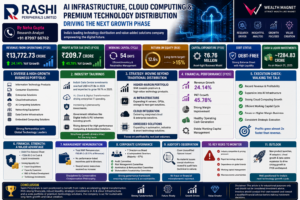
According to the FY25 Annual Report, Revenue from Operations increased 24.14% year-on-year to ₹13,772.73 crore, while Profit After Tax (PAT) surged 45.78% to ₹209.7 crore, significantly outperforming overall industry growth.
Management believes India is entering the next phase of technology adoption, where Artificial Intelligence (AI), cloud infrastructure, enterprise digitalisation, and data centre investments will become the primary engines of long-term growth.
India’s Leading Technology Distribution Platform
Over the years, Rashi Peripherals has evolved from a traditional IT hardware distributor into one of India’s largest technology distribution and value-added solutions companies.
Today, the company operates across multiple high-growth segments including:
- Information Technology Products
- Consumer Electronics
- Enterprise Solutions
- Cloud Infrastructure
- AI Computing Solutions
- Networking Equipment
- Data Centre Infrastructure
- Embedded Computing Solutions
With partnerships across leading global technology brands, the company has established one of India’s widest distribution and service networks.
Industry Tailwinds: Digital India Creating Massive Opportunities
Management highlighted several structural trends that continue supporting long-term industry growth.
India’s economy grew approximately 6.5% during FY25, while enterprise spending on digital infrastructure continued to accelerate.
One of the biggest growth catalysts is India’s rapidly expanding data centre ecosystem.
According to management, investments in Indian data centres reached approximately USD 4.21 billion during 2024, with the sector expected to grow by nearly 19.1% during 2025.
Other long-term industry drivers include:
- Artificial Intelligence adoption
- Enterprise cloud migration
- Digital transformation
- Increasing cybersecurity spending
- Embedded electronics
- High-performance computing
- Consumer technology upgrades
These structural trends are expected to significantly increase demand for enterprise hardware and technology solutions over the coming years.
Growth Strategy: Moving Beyond Traditional Distribution
Management has outlined a long-term strategy focused on increasing profitability rather than simply expanding volumes.
The company is concentrating on four major growth pillars.
Higher-Margin Product Portfolio
Management continues shifting toward premium technology products that offer better margins and stronger customer relationships.
AI Infrastructure
One of the biggest strategic priorities is expanding into AI-driven computing infrastructure.
As Artificial Intelligence adoption increases across enterprises, demand for AI servers, GPUs, storage systems, and networking equipment is expected to accelerate significantly.
Cloud Integration
The company is strengthening its cloud computing capabilities by providing integrated enterprise solutions rather than simply distributing hardware products.
Embedded Solutions
Growing adoption of automation and smart technologies is creating new opportunities in embedded computing and industrial technology solutions.
Financial Performance Demonstrates Strong Execution
FY25 was one of the strongest years in the company’s history.
Key financial highlights include:
- Revenue Growth: 24.14%
- PAT Growth: 45.78%
- Strong margin improvement
- Healthy operating cash generation
- Stable working capital cycle
Despite operating in a highly competitive distribution industry, the company maintained its working capital cycle at approximately 54 days, reflecting strong inventory management and disciplined receivable collection.
Management is also progressing steadily toward its long-term objective of achieving Return on Equity (RoE) above 15%, compared with the current level of around 12.6%.
Execution Check: Walking the Talk
Management appears to be executing its strategy effectively.
Major achievements during FY25 include:
- Record revenue
- Record profitability
- Expansion into AI infrastructure
- Strong cloud computing growth
- Stable working capital management
- Continued focus on higher-margin businesses
The company’s ability to grow profits almost twice as fast as revenue indicates improving operating efficiency and better product mix.
Capital Investment Remains Asset-Light
Unlike manufacturing businesses, Rashi Peripherals operates an asset-light distribution model.
Capital expenditure during FY25 primarily focused on:
- Office infrastructure
- Electrical installations
- Technology upgrades
Capital commitments remain relatively small at approximately ₹6.76 million, reflecting the company’s low-capex business model.
This enables management to generate healthy returns on invested capital while preserving financial flexibility.
Management Remuneration
Total remuneration paid to Key Managerial Personnel during FY25 amounted to approximately ₹30.45 crore, representing only 0.22% of consolidated revenue.
An encouraging governance observation is that the company did not pay performance-linked incentives to directors during FY25, despite delivering strong financial growth.
Several senior executives also received no increase in remuneration, indicating a disciplined and shareholder-friendly compensation policy.
Corporate Governance Overview
Rashi Peripherals maintains a robust corporate governance framework.
The Board comprises:
- 8 Directors
- 4 Independent Directors
- 50% Independent Board representation
Board members collectively possess more than 30 years of average experience across:
- Technology
- Finance
- Corporate Law
- Business Management
Governance oversight is supported through:
- Audit Committee
- Nomination & Remuneration Committee
- Stakeholders Relationship Committee
- Risk Management Committee
The company also maintains regular investor communication and timely regulatory disclosures.
Auditor Observations
Statutory auditors issued a clean unmodified opinion, confirming that the financial statements present a true and fair view.
However, auditors identified one important Key Audit Matter (KAM).
Supplier Rebates
Supplier rebate calculations continue to involve a significant degree of manual processing.
Since rebates represent an important component of profitability, auditors devoted additional attention to testing the underlying calculations and management estimates.
Although no irregularities were identified, investors should continue monitoring improvements in automation of the rebate process.
The company otherwise follows standard Indian Accounting Standards (Ind AS) with no evidence of aggressive accounting practices.
Related Party Transactions & Financial Position
Management confirmed that all related-party transactions were conducted on an arm’s-length basis.
Major transactions included:
- Interest on loans from directors
- Office rent payments
- Borrowings from promoter directors
Outstanding director borrowings stood at approximately ₹20.1 crore as of March 31, 2025.
The company also reported contingent liabilities relating primarily to direct and indirect tax matters.
Management believes these matters are unlikely to materially impact the company’s financial position.
Leadership Changes
During FY25:
- Ms. Hinal Shah stepped down as Compliance Officer while continuing as Company Secretary.
- Mr. Tejas Vyas assumed the role of Compliance Officer.
The transition appears administrative and does not materially impact the company’s governance framework.
Key Risks to Monitor
Despite the strong financial performance, management highlighted several areas requiring continued attention:
- Highly competitive technology distribution industry
- Dependence on global technology vendors
- Manual supplier rebate calculations
- Rapid technology obsolescence
- Margin pressure from competitive pricing
Nevertheless, management believes continued expansion into AI infrastructure and cloud services will improve profitability over the long term.
Future Outlook
Looking ahead, management expects future growth to be driven by:
- Artificial Intelligence infrastructure
- Enterprise cloud adoption
- Data centre expansion
- Embedded computing solutions
- Premium technology products
- Value-added enterprise services
As Indian enterprises continue accelerating digital transformation, Rashi Peripherals expects demand for advanced technology solutions to remain strong.
Conclusion
Rashi Peripherals delivered an exceptional FY25, combining strong revenue growth with even faster profit expansion while maintaining disciplined governance and operational efficiency.
The company’s strategic shift toward AI infrastructure, cloud computing, enterprise technology solutions, and higher-margin products positions it well to benefit from India’s rapidly evolving digital economy.
Supported by a clean audit report, conservative executive remuneration, disciplined working capital management, and a balanced governance framework, the company appears well positioned for sustainable long-term growth.
Although investors should continue monitoring supplier rebate processes, competitive intensity, and technology transition risks, Rashi Peripherals’ execution track record and expanding presence in next-generation technology infrastructure make it one of the more compelling businesses in India’s technology distribution ecosystem.
Overall, the company is successfully evolving from a traditional IT distributor into a value-added technology solutions provider, creating multiple long-term growth opportunities as India’s digital transformation gathers momentum.
Disclaimer: This article is intended solely for educational and informational purposes and should not be construed as investment advice. Investors should conduct their own due diligence and consult a qualified financial advisor before making investment decisions.